Tronxy X1 Mini Reviews: See Why 0 Shoppers Rated It 0 Stars!
Before trusting the stars, check what 0 gadget users said about the Tronxy X1 Mini 3d printer. That 0/5 might not tell the full story.
 Supermod
 Moderator
 Recaptor
Tronxy X1 Mini: A Compact and Accessible Entry into 3D Printing
When exploring the world of affordable 3D printers suited for beginners, the Tronxy X1 Mini emerges as a noteworthy contender. Released in 2018, this FDM/FFF model is designed primarily for consumers eager to prototype and experiment with 3D printing at a foundational level. On paper, its specifications suggest a machine built to balance ease of use with fundamental versatility, making it a solid choice for newcomers dipping their toes into the technology rather than professionals demanding industrial-grade outputs. The blend of a compact footprint, basic yet thoughtful construction, and compatibility with commonly used filaments creates a strong first impression of an accessible, no-frills device tailored for learning and small-scale projects.
Detailed Specs & Features of the Tronxy X1 Mini
The Tronxy X1 Mini's build dimensions stand at 5.91 inches in width, depth, and height, yielding a cubic build volume of approximately 205.9 cubic inches. This build size, while relatively modest, suits hobbyists and consumers focused on smaller, personal print jobs such as prototypes or decorative models. Its single extruder system operates with a standard 0.4mm nozzle diameter.
Still, users can opt for nozzle sizes ranging from 0.2mm to 0.8mm, allowing some control over print detail versus speed. The machine supports common filament types like PLA, TPU, and PETG, all with a filament diameter of 1.75mm, and it even allows third-party filaments, a convenience for cost-conscious users. The printer's maximum extruder temperature of 527°F (275°C) and heated bed reaching up to 140°F enable proper adhesion and layering for a variety of materials. Yet, it lacks a heated chamber, which means printing advanced materials requiring stable chamber temperatures is outside its scope. The direct drive extruder setup favors flexible materials like TPU, yet the absence of a filament drying system or auto-loading mechanism places manual filament management on the user.
For connectivity, the Tronxy X1 Mini uses USB and an SD card interface, compatible with mainstream slicers such as Cura and PrusaSlicer, enhancing accessibility without forcing adoption of proprietary software. Powered externally with a voltage range of 110-220V, it consumes around 120 watts. The machine operates in a temperature envelope suitable for indoor use (59-86°F) and tolerates relative humidity from 20-80%, typical for household environments. Collectively, these measurable core features establish the machine as a versatile, user-friendly printer with sensible thermal and electrical ratings for its intended entry-level audience.
User Experience & Performance Expectations (Driven by Specs)
Design & Build
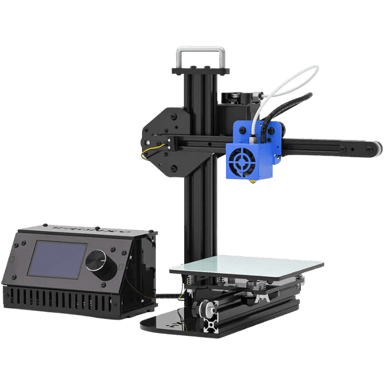
Constructed with a Cartesian frame type, the Tronxy X1 Mini measures a compact 13.39 x 14.37 x 13.78 inches and weighs just over 10 pounds. It arrives as a kit requiring assembly, which can be seen as a feature for enthusiasts wanting to understand their machine better or as a hurdle for those expecting plug-and-play simplicity. The glass build plate, removable for ease of print removal, offers a smooth surface and relies on manual bed leveling, supported by a filament runout sensor that mitigates failed prints due to filament depletion. Despite its open enclosure and absence of chamber lighting or filtration, the printer includes key features such as a touchscreen display for control and cooling fans that help maintain print quality by managing nozzle temperature stabilization during printing.
Performance
The printer's official max print speed clocks in at 150 mm/s, which is quite competitive for a beginner-oriented device, though practically effective speeds are commonly lower to ensure quality. Layer resolution ranges from 100 to 500 microns, enabling modest detail for small crafts or prototypes but not high-definition art pieces. The print accuracy rated at 100 microns suggests respectable precision relative to the segment, while features like spaghetti fault detection and print recovery improve user confidence by addressing common 3D printing mishaps. However, the lack of an auto-bed leveling system may demand more user involvement, particularly from beginners still mastering printer calibration nuances. The operating noise level of approximately 50 dB is typical for such machines, allowing for indoor use without excessive disturbance.
Camera / Display / Audio Quality
While not equipped with a built-in camera or advanced lighting, the touchscreen display facilitates straightforward interaction with print jobs without needing a connected computer each time. The screen size and resolution are unspecified, but the touchscreen feature adds a layer of hands-on control beneficial in a learning environment. The lack of integrated audio features or remote monitoring reflects its beginner-friendly, uncomplicated approach.
Extra Features
Several sought-after enhancements are missing, such as auto-bed leveling, power loss recovery, and wireless connectivity. Yet, essential safety features are present, including CE, FCC, and RoHS certifications and overheat protection, attesting to a certified level of user safety. Its upgrade path includes options like an enclosure mod kit, allowing users to enhance the printer over time, which shows foresight for longevity despite the base model's simplicity. Maintenance requires manual efforts like lubrication and nozzle replacement, supported by the availability of spare parts to extend the printer's usable lifespan.
Pros & Cons
Pros
- Compact and Lightweight Design Facilitates Easy Setup and Placement
- Supports Popular and Flexible Filaments Including PLA, TPU, and PETG
- Touchscreen Display with Filament Runout Sensor and Spaghetti Fault Detection Improves User Experience
- Upgrade Options, Including Enclosure, Available for Future Enhancements
- Certified Safety Standards (CE, FCC, RoHS) Provide Peace of Mind
Cons
- Manual Assembly and Bed Leveling May Be Challenging for Absolute Beginners
- No Auto-Bed Leveling, Power Loss Recovery, or Advanced Monitoring Features
- Open Frame and Lack of Chamber Heating Limit Printing Advanced or Heat-Sensitive Materials
- Absence of Built-in Camera or Remote Print Monitoring Reduces Convenience
Price & Value for Money
Priced at $119 at Alibaba.com, the Tronxy X1 Mini delivers compelling value for those entering the 3D printing hobby without deep pockets. Given its one-year warranty and energy-efficient power consumption of 120 watts, the cost is justified in light of the specs. While it lacks several comfort-enhancing features found in higher-end models, the machine covers all the essentials with competent safety certification and a customizable upgrade path. This printer is best suited for users who prefer to build their understanding manually and are comfortable with hands-on calibration and maintenance, rather than those needing ready-to-go performance or industrial capabilities.
Quick Take
In short, the Tronxy X1 Mini is a savvy choice for entry-level users seeking an affordable and customizable 3D printer. Its compact size, filament versatility, and safety certifications stand out as strong positives. While it doesn't compete with advanced models in automation or feature set, the specifications assure reliable foundational performance for basic prototyping and learning.
Closing Recommendation
The Tronxy X1 Mini may be ideal for beginners willing to invest time in assembly and manual calibration, gaining hands-on experience that serves as a sturdy springboard into the 3D printing world. Its support for popular filaments and optional upgrades helps extend its usability beyond mere novelty. For users seeking out-of-the-box convenience or professional-grade printing, however, exploring more feature-rich models would be advisable.
Verdict
Rating: Based on the specifications and overall feature set, we believe Tronxy X1 Mini deserves 3.8 out of 5.
- Winner Feature => Compact design combined with a versatile filament support and safety certifications offers reliable entry-level printing.
- Needs Improvement => Absence of automation and advanced features like auto-bed leveling and remote monitoring limits ease of use.
Reviews 0
The good, the bad, and the brutally honest.Average Rating


More 3D Printers 453
Unlock more awesome finds.